ios-safari-losing-supabase-session-on-tab-close
Symptom
Users on iOS Safari were logged out every time they closed the tab. Closing
and reopening the PWA from the home screen required signing in again.
Root cause
Supabase stores the session in localStorage by default.
iOS Safari aggressively purges localStorage for PWAs
that haven’t been opened recently, and the purge window is
shorter than most users’ usage pattern.
Fix
Switched Supabase session storage to cookie-based sessions.
Cookies persist across iOS Safari’s localStorage
eviction and survive PWA reinstalls.
reminder-fires-5-hours-late-pkt-utc-mismatch
Symptom
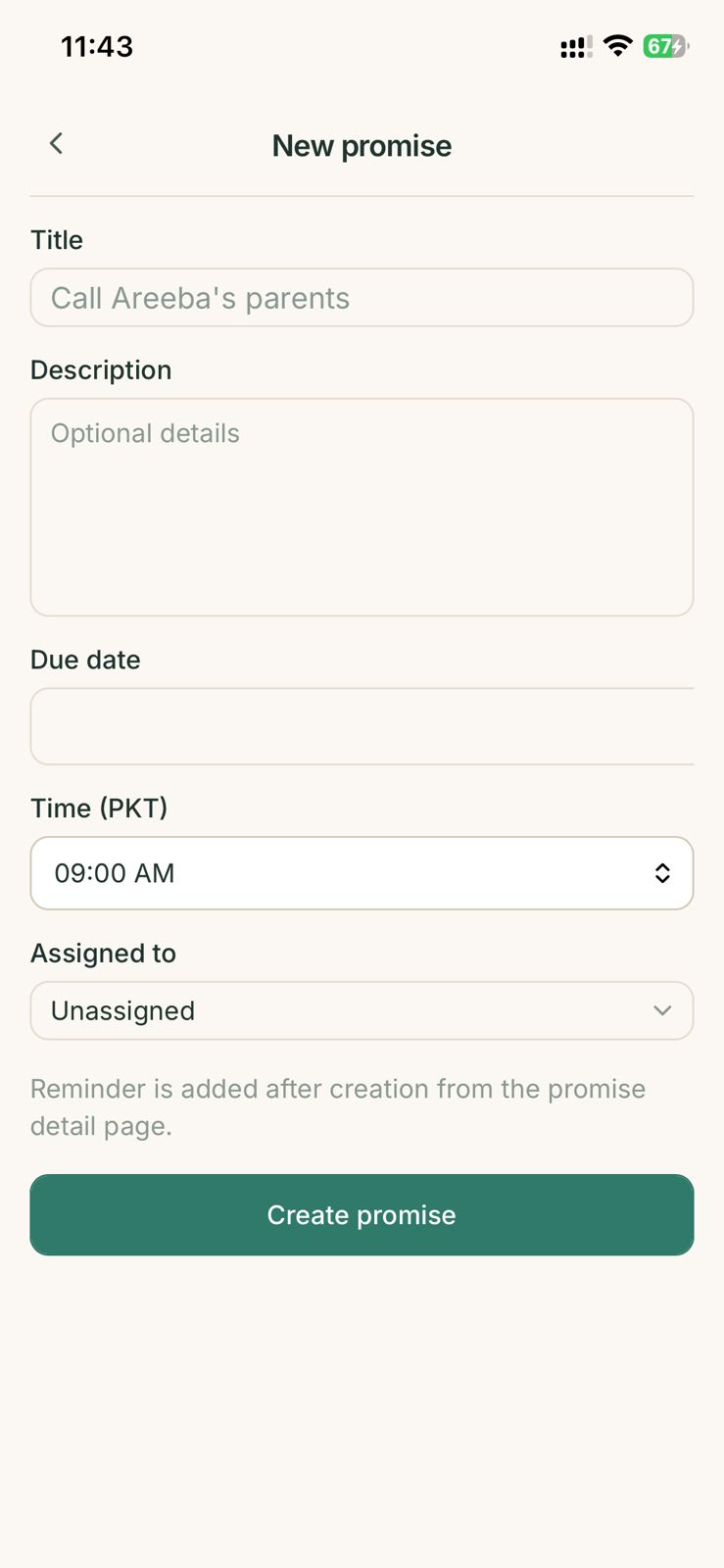
Push notifications for promise reminders arrived exactly 5 hours after
the time the user set. A promise due at 09:00 PKT fired the notification
at 14:00 PKT.
Root cause
The API was writing the PKT hour directly to next_run_at
as if it were UTC. PKT is UTC+5, so a 09:00 PKT entry stored as
09:00 UTC fires at 14:00 PKT.
Fix
Added explicit conversion at write time:
utcHour = (hour - 5 + 24) % 24.
Wrapped in a pktToUtcHour utility and a corresponding
utcToPktHour for display. Both are tested. Neither is
called anywhere except those two functions.
bottom-sheet-backdrop-eating-all-pointer-events
Symptom
Tapping the backdrop behind an open bottom sheet had no effect on mobile.
The sheet stayed open; the dismiss tap didn’t register.
Root cause
The bottom sheet was rendered inside a scroll container. The scroll
container established a new stacking context. The backdrop
div sat visually behind the sheet but was positioned
inside the wrong layer, so pointer events hit the scroll container
before reaching the backdrop handler.
Fix
Moved the bottom sheet and its backdrop to a React portal:
createPortal(sheetMarkup, document.body). Both now render
at the body level, outside all scroll containers and
stacking contexts. Dismiss tap works reliably.
ios-service-worker-push-hanging-on-install
Symptom
VAPID push notifications worked on Android and desktop. On iOS, the
subscription registered without error but no notification ever arrived.
No errors in the service worker console.
Root cause
The service worker hadn’t progressed past the installing
state before the push was attempted. On iOS, a service worker that doesn’t
explicitly call self.skipWaiting() and self.clients.claim()
stays in waiting indefinitely. No active worker means no
push event handler is registered.
Fix
Added explicit install and activate event
handlers to the service worker. The install handler calls
self.skipWaiting(); the activate handler calls
self.clients.claim(). The push handler is now guaranteed
to be active before the first subscription fires.
vercel-hobby-cron-daily-limit-blocking-reminder-cadence
Symptom
Reminders were only firing once per day at most. Promises due at
arbitrary times were missed entirely.
Root cause
Vercel Hobby plan limits cron jobs to once per day. The reminder system
required polling every 5 minutes to catch promises with sub-hour granularity.
Fix
Moved the reminder cron out of Vercel entirely. A GitHub Actions workflow
runs on schedule */5 * * * *, calls the reminder API endpoint
with a shared secret, and has no plan-based frequency limit. GitHub Actions
free tier is generous enough for this cadence.